

Muhammadiyah's Hidden Wealth Explained: Indonesia’s $26 Billion Religious Empire
Discover the untold story of Muhammadiyah, Indonesia’s second-largest Islamic organization and one of the richest religious institutions in the world. They intertwine faith, money, and politics.


Introduction
Religion has always been a fundamental part of human history, helping people connect with the divine. Religious organizations play a crucial role in this, creating communities united by shared beliefs. They are often deeply involved in society, organizing everything from festivals and events to other community initiatives.
However, operating these organizations is much like running a business, as staff and resources require funding. While donations and government support have helped them grow, many have also established their own businesses to generate revenue. This has allowed them to help communities with their vast resources, but it has also led to a significant accumulation of wealth for the institutions themselves.
Many of the world’s most prominent religious organizations have accumulated immense wealth, positioning them among the richest entities globally. While precise figures are often difficult to verify, some estimates place the net worth of organizations like The Church of Jesus Christ of Latter-day Saints at over $200 billion. This level of financial power is comparable to the market capitalization of major multinational corporations, highlighting the significant economic influence of these institutions.
Indonesia’s second-largest Islamic organization, Muhammadiyah, has emerged as the third wealthiest religious organization globally. In 2023, its assets were valued at approximately IDR 400 trillion, or $26.7 billion. Muhammadiyah’s wealth stems from a unique model of religious leadership combined with the ownership of a vast network of hospitals, universities, and other businesses. This approach has allowed it to grow into one of the most financially robust religious organizations in Southeast Asia. This impressive financial standing leads to a persistent question: How did Muhammadiyah accumulate so much wealth, and what do they do with it?
The History and Vision of Muhammadiyah
The roots of Muhammadiyah, founded in Yogyakarta in 1912, trace back to Muhammad Darwis, later known as Kyai Haji Ahmad Dahlan. A direct descendant of Sunan Gresik, one of the revered Wali Sanga who helped spread Islam in Java, Darwis’s journey began with a five-year stay in Mecca during his hajj pilgrimage at age 15. There, he immersed himself in the ideas of prominent Islamic reformists like Muhammad Abduh and Rasyid Ridha. He also connected with other Indonesian pilgrims, and they collectively identified a shared need to revitalize Islam in their homeland and resist Dutch colonial authorities. Before returning to Indonesia in 1888, he adopted the name Ahmad Dahlan, later earning the titles kyai and haji in recognition of his spiritual leadership and completion of the pilgrimage respectively.
K. H. Ahmad Dahlan was an early leader in the Indonesian national awakening, initially joining Budi Utomo in 1909 to promote his reformist ideas. When his supporters encouraged him to form his own organization, he agreed. At the time, he was a prolific religious instructor in his hometown who also taught at various public institutions, such as the Kweek-School in Yogyakarta and the Opleiding School Voor Inlandsche Ambtenaren (OSVIA) in Magelang. His unique life as he simultaneously teaches, trading, engaging in activism, and preaching has helped him to develop an independent, progressive perspective on the need for change within contemporary Islam.
Muhammadiyah stands as the largest and oldest modernist Islamic organization in Indonesia. Its formation was a direct response to the societal stagnation under Dutch colonial rule and the momentum of the global Islamic renewal movement. This belief led him to champion a paradigm of practical, real-world action. The organization was thus founded to remedy three specific issues among Javanese Muslims: a decline in orthodox Islamic practice, a fractured society with rigid class distinctions, and an education system that failed to adapt to modern developments.
K. H. Ahmad Dahlan’s vision for Muhammadiyah was to bridge the gap between faith and modern knowledge. He brought this to life by establishing the “Madrasah System,” which combined religious and secular subjects. This approach was pragmatic because unlike other scholars who rejected Dutch colonial involvement, Dahlan strategically accepted government assistance and adapted methods from various institutions, including Dutch schools and Christian missionary academies.
This pragmatic mindset is rooted in the Islamic concept of ijtihad, or independent reasoning. Muhammadiyah uses this principle to address modern issues pragmatically while staying true to its traditional foundations. This practice of ijtihad is closely linked to tajdid (renewal), as it constantly purifies beliefs from superstition and reformulates Islamic principles to suit changing times. By recognizing that the results of ijtihad are often probabilistic rather than absolute, Muhammadiyah avoids rigid dogmatism and encourages ongoing reinterpretation as seen in the idea of tajdid.
Dahlan’s vision was profoundly shaped by his interpretation of two key Quranic chapters that became foundational to Muhammadiyah’s approach. One was that of Surah al-Ma’un, which posits that individual piety is insufficient without an equal commitment to social piety. The other would be Al-Ashr that emphasizes that ritual worship is meaningless without accompanying acts of social kindness and helping the needy.
These principles directly led to the core concept of Amar Ma’ruf Nahi Munkar (”enjoining what is right and forbidding what is wrong”). This transformed Muhammadiyah into a social reform movement that combines religious duty with tangible action. The organization has institutionalized this by pioneering social entrepreneurship for over a century, long before the term was popularized. Its ventures, such as hospitals, clinics, and orphanages, are created to solve social problems rather than just generate profit. As such, Muhammadiyah views wealth not as a possession but as a tool to continuously promote good and prevent harm in society. The organization reinvests profits from these ventures to sustain and expand its vast network of social institutions, ensuring its assets always benefit the community.
The Core Assets of Muhammadiyah
Muhammadiyah’s immense wealth comes from its massive network of social organizations whose goals are for the benefit of its community. The organization focuses on four areas that have become the core center of their social organization and wealth-making source: religion, education, economy, and social affairs.
Education is arguably Muhammadiyah’s most important area as it is the basis of the organization’s goal and foundation, which even predeceased the organization itself, seen by the establishment of Madrasah Ibtidaiyah Diniyah Islamiyah (MIDI) in Yogyakarta on December 1st 1911, a full year before the establishment of the organization itself, symbolizing the integral role education has in the vision of Muhammadiyah under K. H. Ahmad Dahlan.
Muhammadiyah’s education program is divided into two main sections: Madrasahs and general schools. Madrasahs are Islamic religious schools that fall under the Ministry of Religious Affairs and combine Islamic and general education. Meanwhile, general schools align with national standards and are overseen by the Ministry of Primary and Secondary Education, blending modern subjects with Islamic values. While Madrasahs focus on intensive Islamic studies, general schools offer a broader secular curriculum with Islam as a single subject.
Regardless of these differences, all Muhammadiyah schools share a common purpose rooted in the vision of K.H. Ahmad Dahlan which emphasizes integrating Islamic values with modern knowledge and social responsibility, embodying the principle of Amar Ma’ruf Nahi Munkar (enjoining good and forbidding evil). This emphasis is made possible by the ISMUBA curriculum, which is taught in all Muhammadiyah schools, including those following the national curriculum. ISMUBA, which stands for Al-Islam, Muhammadiyah Studies, and Arabic Language, ensures all students develop a strong Islamic character and a deep understanding of the organization’s mission.
In addition to day schools, Muhammadiyah also runs Pesantren (Islamic boarding schools) and universities. Similar to madrasahs, pesantren primarily serve as religious schools but with a boarding component. Muhammadiyah’s universities, on the other hand, are private institutions that aim to produce well-rounded, ethical professionals by balancing academic rigor with Islamic values and a focus on social entrepreneurship. They also emphasize research and community service. Muhammadiyah’s success in this sector has made it one of Indonesia’s leading educational organizations, with its universities consistently ranked among the top private institutions in the country.
Muhammadiyah is also one of Indonesia’s most important actors in the healthcare sector. It is one of Indonesia’s largest actors in the private healthcare sector, making them an integral actor in Indonesia’s healthcare system. Much like their role in the education sector, Muhammadiyah’s role in the sector predeceased even Indonesia’s independence, highlighting the importance of health as much as education for the betterment of society. This can be seen with the establishment of Penolong Kesengsaraan Oemoem (PKO), or now known as RS PKU Muhammadiyah Yogyakarta in February 15th 1923.
The organization’s healthcare services encompass comprehensive medical care including 8,082 hospital beds across 17 provinces, with varying levels of service from basic community clinics to advanced specialized hospitals. Muhammadiyah hospitals provide services ranging from general medical care to specialized treatments, with some facilities offering presidential suite-class accommodations while maintaining their commitment to serving the economically disadvantaged.
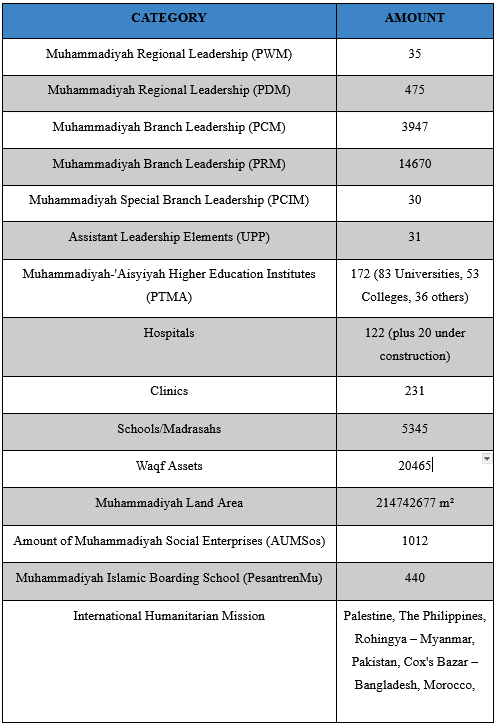
Due to their deep involvement in the education, health, and social sector, it cannot be emphasized enough that Muhammadiyah plays a crucial role in the economy, making it one of the core assets of the organization. In total, Muhammadiyah’s assets consist of thousands of entities spread across Indonesia, which are controlled by every level of organization within Muhammadiyah.
Muhammadiyah’s economic impact extends far beyond its direct operations, benefiting over 10 million Indonesians annually across various service categories. Healthcare services reach 4.7 million patients annually through hospitals, clinics, and specialized medical centers, representing approximately 2% of Indonesia’s total population.
Student beneficiaries number 1.9 million across all educational levels, from kindergarten through university education. This student body represents the largest private educational network in Indonesia and contributes significantly to national human capital development.
Employment impact encompasses 1.3 million people when including both direct (450,000) and indirect (850,000) employment. Direct employment costs approximately Rp 18 trillion annually, making Muhammadiyah one of Indonesia’s largest private sector employers. Indirect employment through supply chains, construction, and service providers generates an additional Rp 25 trillion in economic activity.
The Managed Wealth of Muhammadiyah
The foundation of Muhammadiyah’s wealth lies in the Amal Usaha Muhammadiyah (AUM). These charitable enterprises, which include everything from schools and hospitals to profit-oriented ventures, serve as the practical vehicle for the organization’s dakwah (preaching). While Muhammadiyah serves as the mass organization whose goal is to preach and spread the message, AUM is, as previously mentioned, the practical vehicle for the organization’s use and benefit. Due to this, AUM operates on a hybrid model, where they generate revenue not for organizational enrichment, but to support the core mission as preached by Muhammadiyah.
Muhammadiyah’s approach stems directly from the foundational interpretation of Surah Al-Ma’un, which emphasizes caring for orphans and the needy. Consequently, all surplus funds are strictly reinvested into three areas: expanding the AUM, operational dakwah activities, and employee welfare, thereby translating religious duty into tangible social action.
Based on the total assets that Muhammadiyah controls, which has been explained before, the organization’s wealth is worth up to Rp 400 trillion, but this figure remains unclear. Indonesia puts the government, personal, as well as other waqf institutions as managers to whom the waqf was entrusted. Muhammadiyah, as one of the largest management waqf assets in Indonesia, maximizes its waqf’s benefits through Muhammadiyah Business Charity (AUM).
AUM operates under a sophisticated hierarchical governance system that ensures accountability and adherence to Muhammadiyah’s core mission. The leadership structure follows several key principles established by the Central Executive Board:
Leadership Appointment and Oversight: AUM leaders are appointed and dismissed by the respective Muhammadiyah leadership at their appropriate levels within specific timeframes. This ensures that leadership positions are treated as temporary trusts rather than permanent positions, preventing the perception of AUM as personal or family property.
Professional Qualifications: AUM leaders must be Muhammadiyah members who possess specific expertise relevant to their charitable business sector. They are required to demonstrate strong commitment to Muhammadiyah’s mission, understand the proper function of AUM, and view their role as more than merely earning a livelihood.
Transformational Leadership Approach: Research indicates that AUM leadership exhibits high levels of transformational leadership characteristics, including charisma, individual consideration, intellectual stimulation, and inspirational qualities. This leadership style has proven effective in advancing AUM operations while maintaining alignment with organizational values.
The financial governance of AUM follows stringent principles designed to maintain transparency and prevent misappropriation. Asset ownership remains entirely with the Persyarikatan (the Muhammadiyah organization), not with individual leaders or managers. All AUM assets must be properly inventoried and protected with legitimate legal ownership documents.
Centralized Management Systems have been implemented to optimize financial operations. The Muhammadiyah Central Executive established integrated cash management systems through partnerships with Islamic banks, ensuring that funds are managed productively, effectively, and accountably. This system includes:
Coordinated financial management across all organizational levels
Standardized profit-sharing arrangements with Islamic banking partners
Transparent reporting and auditing procedures
Cross-sectional resource management to support struggling
Muhammadiyah’s approach to wealth management demonstrates its commitment to social impact over profit maximization. All surplus generated by AUM is reinvested according to a strict three-pillar allocation system:
Operational Dakwah Activities: Funding for religious preaching, community outreach, and Islamic education programs
AUM Expansion and Development: Investment in expanding existing facilities and establishing new charitable enterprises
Employee Welfare: Ensuring fair compensation and benefits for AUM staff and workers
Importantly, Muhammadiyah’s Central Executive does not extract dividends or large profits from AUM operations. This distinguishes the organization from typical business entities and reinforces its commitment to community benefit rather than organizational enrichment.
Its wealth is self-regulated and circulates within the organization itself, making it largely independent from external economic fluctuations. The Majelis Ekonomi dan Kewirausahaan (MEK), which is the Economics and Entrepreneurship Council, spearheads efforts to create a “closed-loop economy” within the Muhammadiyah community. This system encourages:
Storing funds in Muhammadiyah-affiliated financial institutions
Prioritizing internal business partnerships and procurement
Developing integrated economic networks among AUM units
Creating self-sustaining economic ecosystems within the organization
In recent years, AUM has been increasing its influence across the Indonesian economy. This is partly due to the organization’s strategic focus on economic empowerment as the “third pillar” of its dakwah movement, formally established at the 47th Muhammadiyah Congress in Makassar in 2015. The MEK now actively promotes entrepreneurship education, digital economy literacy, and financial inclusion programs to strengthen the economic capacity of Muhammadiyah communities.
Through this comprehensive approach to wealth management, Muhammadiyah has created a unique model that balances business efficiency with social responsibility, ensuring that its substantial assets serve both the immediate needs of Indonesian society and the long-term sustainability of its religious and educational mission.
The Asset Redistribution of Muhammadiyah’s AUM
The asset distribution analysis reveals Muhammadiyah wealth and how they distribute it throughout the organization. Based on past explanations, it can be seen that the wealth of Muhammadiyah is large and substantial.
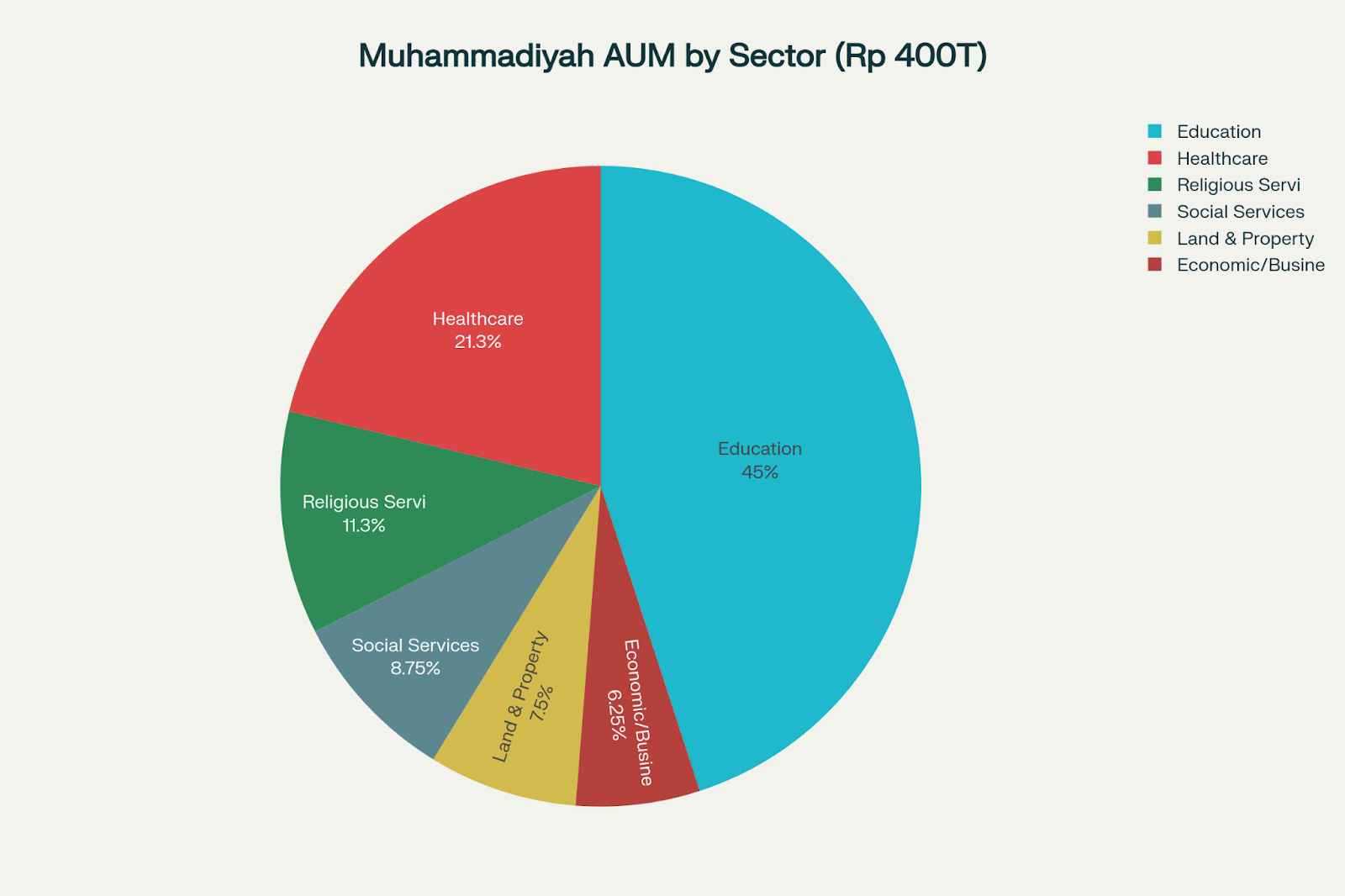
Muhammadiyah’s strategic prioritization of education and healthcare sectors, which together account for 66.3% of total organizational wealth. Education represents the largest single sector at Rp 180 trillion (45%), reflecting the organization’s historical commitment to advancing Islamic education and its role as the largest private education provider in Indonesia.
Healthcare assets worth Rp 85 trillion (21.3%) demonstrate Muhammadiyah’s substantial investment in medical infrastructure, operating 142 hospitals and 313 healthcare facilities nationwide. This significant healthcare investment aligns with the organization’s interpretation of social welfare obligations under Islamic teachings.
Religious services account for Rp 45 trillion (11.3%), encompassing over 11,000 mosques and prayer facilities. The remaining sectors—social services, economic/business ventures, and land holdings—represent strategic diversification efforts totaling Rp 90 trillion (22.5%).
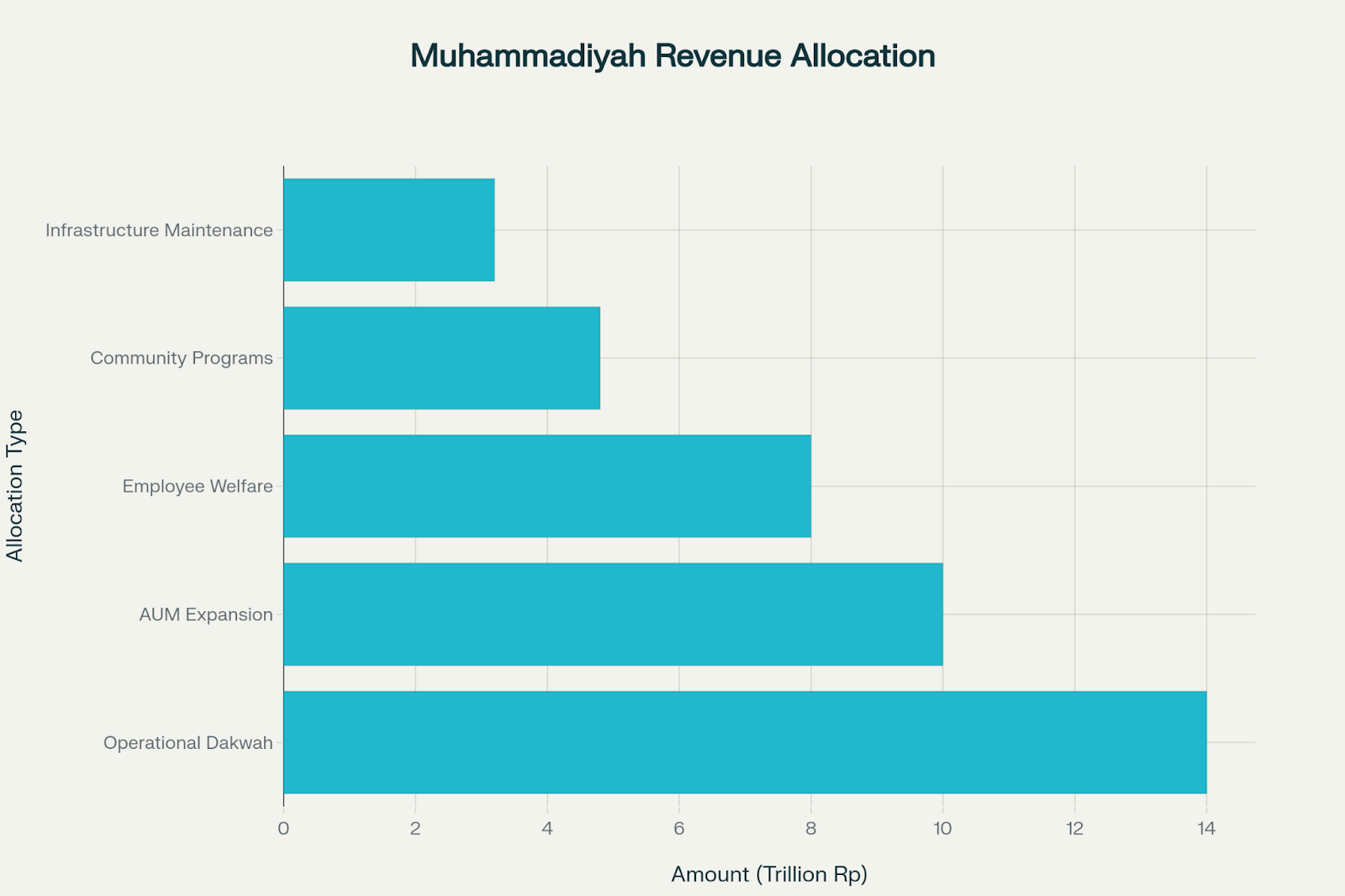
Muhammadiyah’s revenue allocation follows its distinctive three-pillar system, distributing approximately Rp 40 trillion in annual revenue according to strict reinvestment principles. The allocation prioritizes operational dakwah activities (35%, Rp 14 trillion), ensuring the organization’s core religious mission receives primary funding support.
AUM expansion receives 25% (Rp 10 trillion) of annual revenue, enabling continuous growth of charitable enterprises across Indonesia. This substantial reinvestment explains Muhammadiyah’s consistent expansion, with an average of 230 new AUM units established annually between 2020-2024.
Employee welfare allocation (20%, Rp 8 trillion) demonstrates the organization’s commitment to its 450,000 direct employees, ensuring competitive compensation within the charitable sector. Community programs and infrastructure maintenance receive the remaining 20% (Rp 8 trillion), supporting broader social impact initiatives.
The five-year financial performance analysis demonstrates consistent growth across all key metrics. Total assets increased by 25% from Rp 320 trillion in 2020 to Rp 400 trillion in 2024, representing an average annual growth rate of 5.7%.
Annual revenue growth has been particularly robust, increasing 60% from Rp 25 trillion to Rp 40 trillion over the same period. This growth rate of 12% annually significantly exceeds Indonesian GDP growth, indicating Muhammadiyah’s expanding market share and operational efficiency improvements.
Surplus for reinvestment has more than doubled from Rp 3 trillion to Rp 7 trillion, demonstrating improving operational margins and enhanced capacity for organizational expansion. This surplus growth enables accelerated AUM development while maintaining service quality standards.
The economic circulation within Muhammadiyah’s ecosystem is estimated to reach trillions of rupiah. In Jakarta and surrounding areas alone, the organization’s economic contribution is estimated at Rp 2 trillion, with the national figure substantially higher.
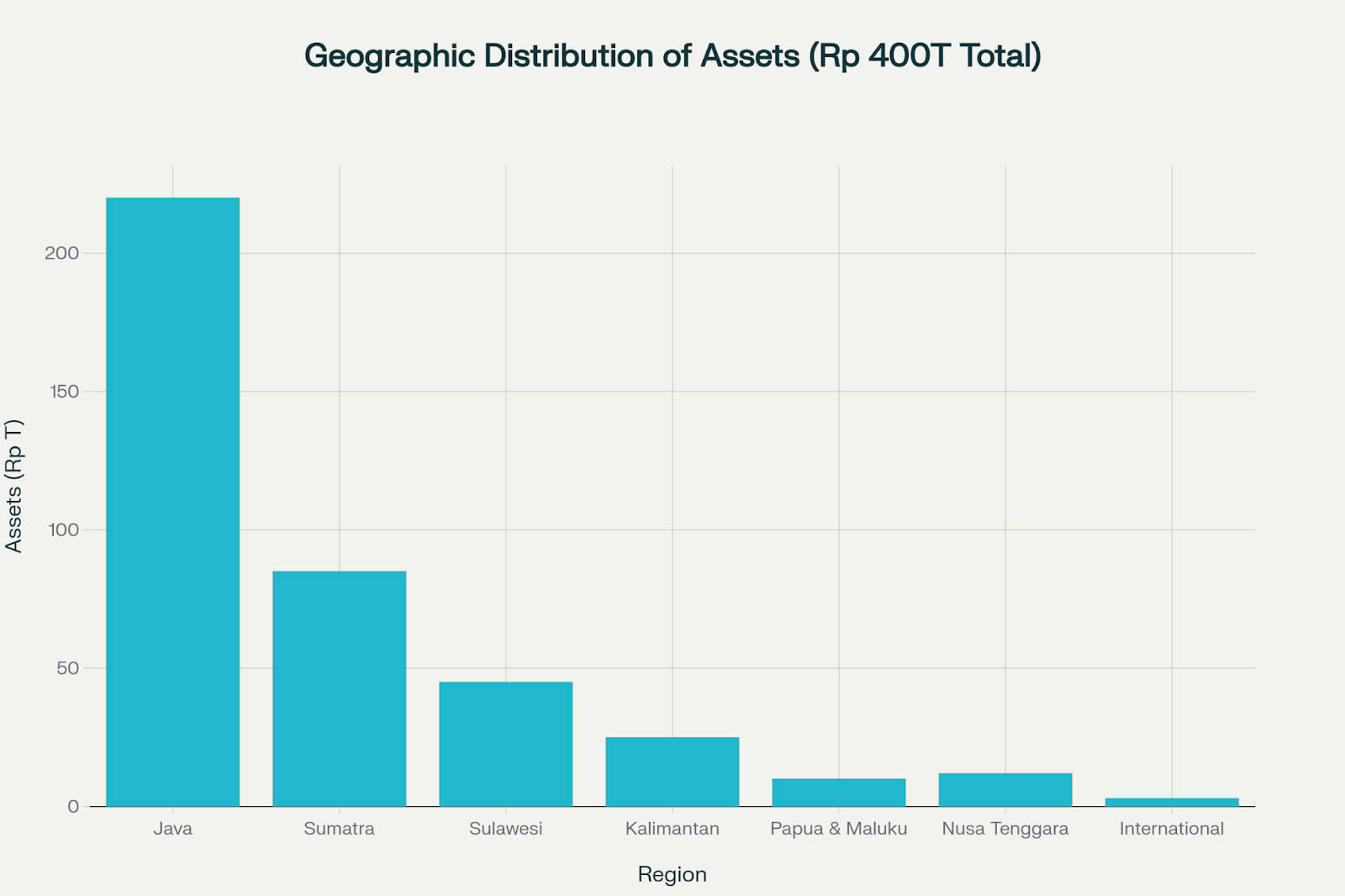
Geographic analysis further reveals a significant concentration of assets in Java, which holds 55% (Rp 220 trillion) of total organizational wealth. This concentration reflects Indonesia’s population distribution and economic activity patterns, where Java hosts approximately 60% of the national population.
Sumatra represents the second-largest asset base with Rp 85 trillion (21%), followed by Sulawesi with Rp 45 trillion (11%). The outer islands—Kalimantan, Papua & Maluku, and Nusa Tenggara—collectively hold Rp 47 trillion (12%), indicating strategic expansion into underserved regions.
International assets worth Rp 3 trillion support Muhammadiyah’s global presence through institutions in Malaysia, Australia, and the Middle East, demonstrating the organization’s commitment to international Islamic education and humanitarian work.
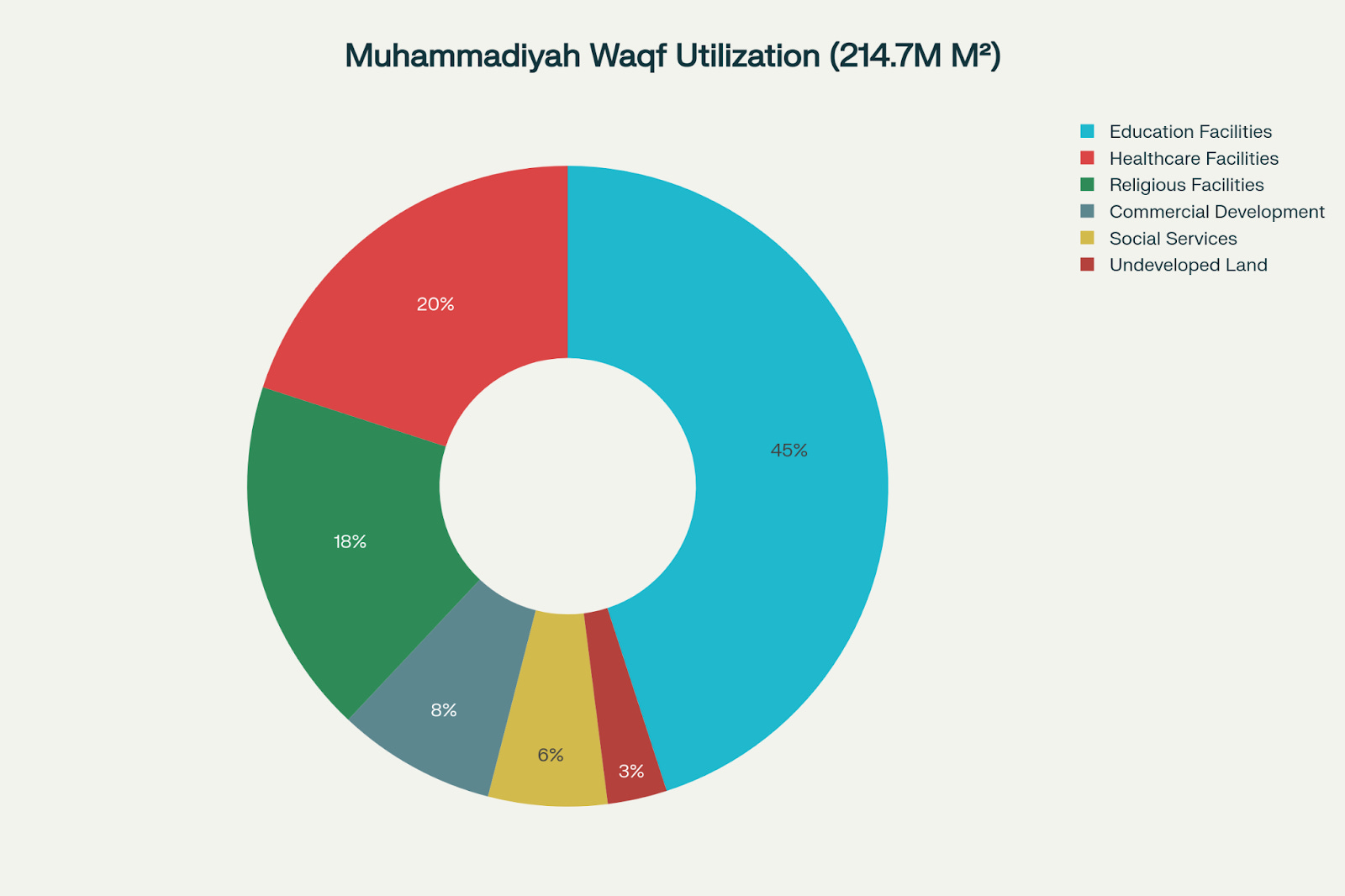
Based on geographical analysis, we can also understand the usage of the vast lands that Muhammadiyah acquires through Waqf. Analysis of waqf asset utilization shows strategic deployment of 214.7 million square meters of donated land. Education facilities occupy 45% of waqf land (96.6 million M²), valued at approximately Rp 180 trillion, making Muhammadiyah the largest private landowner dedicated to educational purposes in Indonesia.
Healthcare facilities utilize 20% of waqf land (43 million M²), supporting the organization’s extensive medical network. Religious facilities account for 18% (38.7 million M²), providing infrastructure for daily prayers, religious education, and community gatherings.
Notably, only 3% of waqf land remains undeveloped (6.4 million M²), indicating highly efficient asset utilization. This efficient land use contrasts sharply with many Indonesian waqf institutions, where significant portions of donated land remain unproductive
Criticism of Muhammadiyah and AUM
Despite Muhammadiyah’s substantial achievements and economic influence, the organization and its wealth management practices have faced significant criticism from multiple quarters. These criticisms range from concerns about transparency and governance to questions about social justice and organizational priorities.
One of the most persistent criticisms of Muhammadiyah concerns its perceived transformation from a progressive reform movement into a more conservative, elite-oriented organization. During the New Order era (1966-1998), critics argued that Muhammadiyah’s leadership became co-opted by the authoritarian regime, abandoning its traditional role as advocate for the marginalized.
This criticism was particularly sharp regarding Muhammadiyah’s silence during major human rights violations and land grabbing incidents. When thousands of farmers were displaced by the Kedung Ombo Reservoir project in the 1980s, affecting 5,268 families across 37 villages, Muhammadiyah remained conspicuously silent while its rival organization Nahdlatul Ulama actively supported the victims. Critics argued that Muhammadiyah’s elite had become “trapped in a culture of obeying the authorities,” prioritizing relationships with power over defending the weak.
This pattern of political quietism has led to accusations that Muhammadiyah’s wealth and institutional interests have made it risk-averse when confronting systemic injustice, contradicting the organization’s founding principles of amar ma’ruf nahi munkar (commanding good and forbidding evil).
Contemporary research has revealed how Muhammadiyah’s education system inadvertently reproduces class distinctions through its charitable business model. Academic studies demonstrate that while AUM units ostensibly serve diverse populations, the organization has created a hierarchical system where elite schools adopt economic schemes to subsidize non-privileged institutions.
This “dialectic institutionalization” has created what researchers term “dominant class concentration” within Muhammadiyah schools, where prestigious institutions serve affluent families while positioning themselves as benefactors of less privileged schools. Critics argue that this model, while maintaining program independence from state control, effectively legitimizes educational inequality by making stratified institution quality socially acceptable.
The concern extends to Muhammadiyah’s approach to Islamic education for non-Muslim students, which some view as potentially coercive proselytization despite organizational claims of voluntariness. This has raised questions about whether educational AUM units prioritize conversion over genuine educational service.
Muhammadiyah has faced persistent criticism regarding financial transparency across its AUM network. Research on financial accountability reveals significant deficiencies in reporting standards and oversight mechanisms. Many AUM units continue to use “manual or simple methods” for financial recording, with some institutions only tracking basic cash inflows and outflows without comprehensive financial statements.
The lack of standardized financial reporting has created challenges for stakeholders seeking to understand how resources are allocated and utilized. This opacity becomes particularly concerning given the organization’s substantial asset base and the public trust placed in its charitable mission.
Issues with Leadership Competency and Management also plague the system. Studies identify significant barriers in Muhammadiyah’s waqf management, particularly regarding “low competency and low enforcement in management and regulation” among leadership (Nazhir). These governance weaknesses have prevented the organization from maximizing the productive potential of its assets, with researchers noting that many waqf properties remain underutilized despite their commercial potential.
The most prominent recent criticism emerged from Muhammadiyah’s controversial withdrawal of approximately Rp 13-15 trillion from Bank Syariah Indonesia (BSI) in 2024. This decision, formalized in Memo 320/1.0/A/2024, sparked widespread public debate about the organization’s financial decision-making processes and priorities.
Public sentiment analysis revealed predominantly negative reactions, with approximately 65-70% of netizens expressing distrust in both the government and BSI, while 55-60% supported Muhammadiyah’s proposal to establish its own bank. The controversy highlighted several underlying tensions:
Concentration Risk Concerns: Muhammadiyah justified the withdrawal by citing excessive concentration of funds in a single institution, arguing this created unhealthy competition in the Islamic banking sector. However, critics questioned whether such a massive, coordinated withdrawal itself posed systemic risks to Indonesia’s Islamic banking stability.
Service and Representation Issues: Reports suggested that Muhammadiyah’s dissatisfaction stemmed from BSI’s perceived prioritization of large corporate clients over small and medium enterprises (UMKM), conflicting with Muhammadiyah’s community-focused mission. Additional tensions reportedly arose over BSI’s leadership appointments and service quality concerns.
The withdrawal’s immediate impact on BSI’s stock price, which fell 20 basis points following the announcement, demonstrated the substantial market influence Muhammadiyah’s financial decisions can wield. This raised questions about whether the organization adequately considered the broader economic implications of its actions.
Muhammadiyah faces a growing crisis in leadership development within its AUM network. Critics point to a fundamental disconnect where young employees working in AUM institutions lack a deep understanding of Progressive Islam philosophy or the movement’s core principles. This “cadre crisis” manifests in several ways:
Professional vs. Ideological Orientation: Many AUM staff view their positions primarily as employment opportunities rather than mission-driven service, weakening the organizational culture that traditionally bound the movement together. The result is that AUM institutions increasingly operate as conventional businesses rather than value-driven charitable enterprises.
Educational Institution Preference Paradox: Even committed Muhammadiyah families often choose non-Muhammadiyah schools for their children, undermining AUM educational institutions. This preference pattern suggests that the organization’s own constituency questions the quality or appeal of Muhammadiyah educational offerings, creating a sustainability challenge for the educational AUM network.
Muhammadiyah’s healthcare AUM units face particular criticism regarding human resource management and institutional coordination. The organization struggles with what researchers term “management problems consisting of principal leadership management, finance, and human resources”.
Doctor Retention Issues represent a significant challenge, where the majority of medical graduates from Muhammadiyah universities do not return to serve in AUM healthcare facilities. Despite producing 720 doctors annually along with thousands of nurses, midwives, and pharmacists, AUM healthcare institutions remain understaffed and must recruit from non-Muhammadiyah institutions.
This brain drain undermines the organization’s vision of creating an integrated Islamic healthcare network and raises questions about whether AUM educational institutions adequately instill organizational loyalty and mission commitment in their graduates.
Perhaps the most fundamental criticism concerns whether Muhammadiyah’s wealth accumulation and management aligns with Islamic principles of social justice. Research on Islamic economics and poverty alleviation suggests that wealth concentration, even within charitable organizations, can perpetuate inequality.
Critics argue that while Muhammadiyah claims to follow Surah Al-Ma’un’s teachings about caring for the poor, the organization’s substantial asset accumulation and elite institutional focus may contradict these principles. The fact that many AUM institutions serve middle and upper-middle-class constituencies while claiming to benefit the poor has led to questions about whether the organization has become part of the problem it originally sought to address.
Academic analysis of Muslim middle-class formation suggests that organizations like Muhammadiyah may inadvertently contribute to “bourgeoisification” processes that separate religious elites from grassroots communities. This transformation potentially undermines the organization’s capacity to serve as an authentic voice for social justice and economic equity.
The convergence of these criticisms reveals fundamental tensions between Muhammadiyah’s institutional success and its founding mission. While the organization has built impressive infrastructure and accumulated substantial wealth, questions remain about whether these achievements serve the broader goals of Islamic social reform or have become ends in themselves, potentially compromising the movement’s original transformative vision.